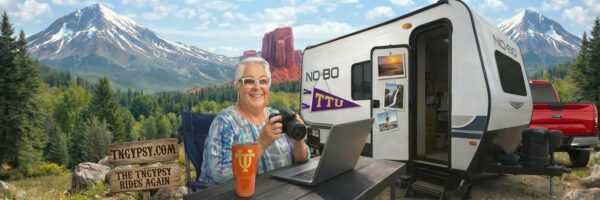
The scenery had been pretty in a majestic, grand sort of way. Cheryl and Doug told me to be prepared, because I was going to see a lot more of this and it was going to get even more impressive. The question was — how many times can you stop and take a picture of a hillside, a lake, a mountain with snow on it, and green trees, both evergreen and spring green deciduous trees?

I’m sure the answer for Doug was a lot more than he thought anyone would want to do that. But he was patient with me and let me grab the shots I really wanted to catch, as I wondered when a picture would become redundant or when a picture would become the piece de resistance.

When we left Prince Rupert, we were headed for Whitehorse, Yukon, with a stop in a small community called Dease Lake. The next day we entered Whitehorse, Yukon. This was a real treat for me because while I had always hoped to get to all of the Canadian provinces, getting to the territories of Yukon, Nunavut, and Northwest Territories had never been something I expected to be able to do. I just thought they were way too out there. But experiencing the Yukon was an amazing opportunity that I’m thrilled I got a chance to see. The Yukon is desolate. It’s a long time between potty stops. The roads are mostly either gravel or under construction and therefore — gravel. You can drive for miles without seeing another car. And it is a very long tedious drive — Thanks Doug!

We left Dease Lake, British Columbia, and got on Highway 37, also known as the Stewart-Cassiar Highway. It would eventually intersect into the Alaska Highway. We hadn’t been driving more than 10 minutes when we encountered a moose in the middle of the road! Of course, my camera wasn’t ready. And we spooked the moose and he ran off into the woods very quickly. Those creatures can really move.
We kept heading north and after a while, I realized we had not seen another car, not in front of us, nor behind us, nor coming toward us. A little later, we saw a bear. Then, we saw squirrels and rabbits and deer and more bears. I started keeping track and realized that in the first four hours of our trip, we saw more wildlife on the roads or near the roads than we saw other vehicles.

The Grizzlies were striking due to their color differences while the buffalo was just small. Apparently, there are Plains Bison and Wood Bison. The Wood Bison is smaller than the Plains ones, but they still look big enough and fierce enough to want to stay far away from. “Do Not Pet the Fluffy Cows!”
Having grown up in the suburbs and lived most of my life somewhere where there’s at least some reasonable amount of people, this was just unfathomable to me. We were on a major highway in a province or a territory and did not see anybody.
The Yukon has a population of about 44,000 people and Whitehorse, its capital, has a population of about 33,000. That means that in the entire rest of the province, there’s only 11,000 people. The population density of the Yukon is calculated to be .008. However, if you remove the Whitehorse population area and calculate the real density of the non-urban area, I am not sure I have enough digits in the decimal places.

While I’m used to the sparsely settled areas of Nebraska and Wyoming, this was just a number that I could hardly fathom. We drove for miles and miles without seeing any signs of human existence. No cell service, no internet, no restaurants, no gas, and only occasionally rest areas with potty stops that were open. And oh yeah, the potty stops were outhouses!
But the natural beauty of the world around me was impressive. There were no power lines in places we would normally see them. No obstructions from the view of the machinery or buildings. And you never knew what was around the next corner. While I wished for sunnier skies, my favorite views were around Kluane Lake. This lake is located on the Alaska Highway near the community of Destruction Bay. The community was named because a fierce wind storm blew down the military’s temporary housing during a road construction project in the early 1940s.

The Alaska Highway (or the ALCAN Highway) is 1,700 miles, from Dawson Creek, British Columbia to Delta Junction, Alaska. Built as a military route for the Canadian and U.S. militaries, back when the U.S. cooperated with its neighbors, it was completed in just nine months and both countries’ forces participated in its construction. On this leg of our trip, we picked up the ALCAN at Watson Lake, where the Stewart-Cassiar intersected it. In the entire 1,700 miles, there are only 12 significant intersections.
Whitehorse was a small community that housed government offices, so it was slightly larger in commercial activity than its population might indicate. We were happy to see available gas and restaurants. We spent the night in Whitehorse, and the next day would make the U.S. border and Alaska. I was excited to see what came next.
