As I left Voyageurs National Park, I headed south. I first came upon the city of Duluth, Minnesota. I’m not sure what I had in my head, but I don’t think I envisioned a natural resources port as large as this one. It was interesting to see all the different types of facilities there for holding, crushing, managing, and then shipping the various natural resources and agricultural products that apparently come through Duluth.
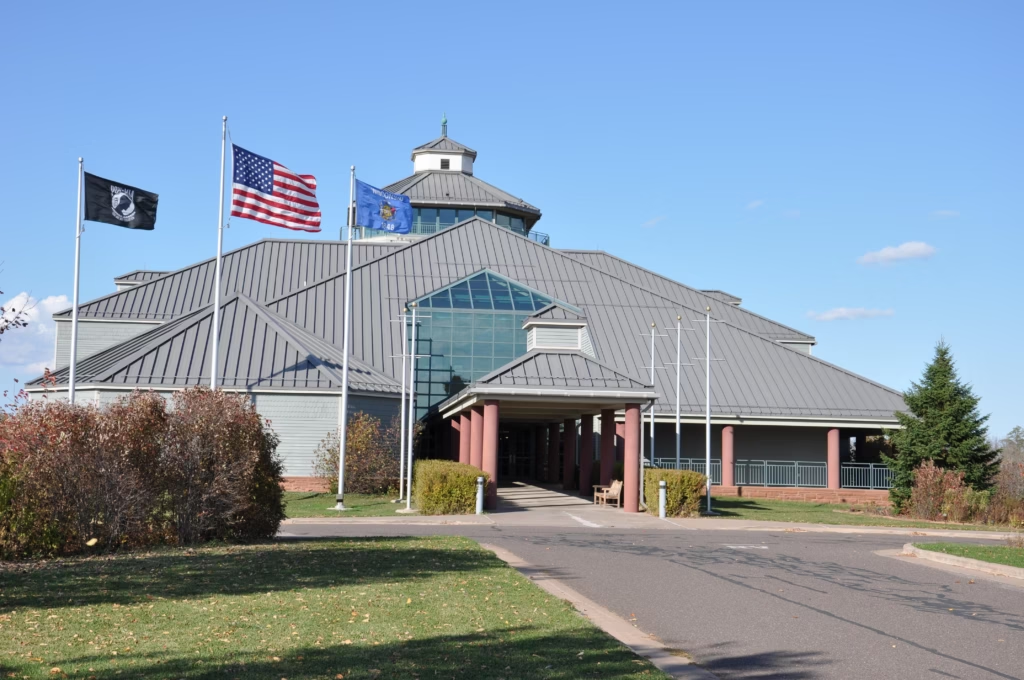
I just barely touched Wisconsin but in Ashland, I came across the Northern Great Lakes Visitor Center. It was in a Wildlife Refuge on the shores of Lake Superior. I stopped, took a brief look around. It was interesting but largely a repeat of much of the information that had been at Voyageurs. But the real reason for my stop was to grab postcards for the grandchildren. . A good selection was available, which was good news for my 12 year old granddaughter, who is mapping my trip through the postcards I send. Now, she can add Wisconsin to the list of state postcards she has received.

I then made my way along the southern portion of the Upper Peninsula. I had driven the northern loop in 2013, and this time, I wanted to see the southern loop. I spent a couple of days at the Bewabic State Park in the UP. It was quiet and beautifully green. It actually reminded me of my Girl Scout camp in Southwestern Ohio. But the real treat there was the opportunity to hear and capture this picture of a Barred Owl.

There were many opportunities to see Lake Michigan along a road that, for the most part, hugged the shoreline. The smoke from the Manitoba wildfires had been creeping in, so I was missing some of the beauty that clear days and bright sunshine bring. But I got a few glimpses here and there. It wasn’t a super long drive, just about four hours, and I arrived in Saint Ignace, Michigan.

Saint Ignace is the northern city to Mackinaw City, both of which are ferry points to Mackinac Island. The Big Mac, the local nickname for the Mackinac Bridge, connects the Upper Peninsula to the Lower Peninsula of Michigan. Tourism is pretty much the only industry in both communities: campgrounds, hotels, tourist shops, restaurants, and bars.
The next day, I went across the Big Mac to Mackinaw City. I was confused as to why Mackinaw City was pronounced Mak in “naw” and Mackinac Island was also pronounced Mak In “naw”. Thank you, Google, for the answer. Mackinac Island is a shortened version of the Native American name, Michilimackinac, and the ac was pronounced “naw” in the native dialect. When Mackinaw City was formed, they decided to keep the pronunciation, but change the spelling to better reflect the English language.

I had reservations for the ferry the next day. In chatting with local campers, I found out there’s a free shuttle service from the campgrounds and hotels to the ferry site. I appreciated that $15 savings. As there are no motorized vehicles on Mackinac Island, the ferry is simply a passenger ferry. Commercial goods come in via boat. It’s about a 15-minute ride from the mainland to the island.
As approached the port on Mackinac Island, there was a cargo ferry next to us, and I took note, somewhat amusingly, that one of the prime cargos they had to haul was hay. Animals need to eat! The wagons that carry people and goods on the island are pulled by more than 300 horses. There’s not a lot of acreage on the island to grow hay, so it is brought in by cargo boats. There were aquatic birds along the shore that I couldn’t help photographing as we waited to disembark.

As expected, the island is beautiful. The architecture is decidedly 1920s, carefully preserved. I walked more this day than I had walked in months. I felt it the next day too. I did that much walking even though my primary form of transportation around the island was by carriage.

Our carriage tour wandered through the old town for a little while, and then carefully made its way up towards the top of the island. We started on a two-horse carriage, and when we got to the top of the island, we got off and there was either a different carriage down or a three-horse carriage to go even farther into the island.

I had paid for the full package, so the first thing I did was go to Wings Over Mackinac, which is a beautiful butterfly gallery. I spent over an hour trying to capture perfect pictures of all the species of butterflies. I wasn’t successful completely, but I did really well with a few of them. The one I’m proudest of is the blue butterfly, which never seemed to land in a spot where you could photograph it. It always was in flight, fluttering or hidden. When I finally decided I couldn’t do any better than what I had done, I got on the three-horse carriage ride and went to the fort.

Our guide on this portion of the trip was not only well-informed, but he was also funny. And I admit, I had a little fun. He talked about the number of times the fort had been in play as an outpost to fight the British in the early days of the republic. It had been captured by the British at one point, and the Americans spent quite a bit of time and lives trying to retake it. Then, by treaty, it was given back to the U. S. The fort was then decommissioned when relationships between the U. S. and Canada improved to where we didn’t need an outpost on this border.

Being ever sarcastic, I piped up from the back and asked if we thought we would be recommissioning it, since it looked like we might be going to war with Canada again. The guide didn’t quite know what to say about that. I heard a few snickers around the carriage, and I got a couple of scowling looks, so I kept my mouth shut from there on out.

As we headed down the hill toward The Grand Hotel, we came across the governor’s mansion, which was the summer residence for the governor in the early 1900s. The family sold it to the state of Michigan for $15,000 with a proviso in the sales agreement that should the state ever want to divest themselves of the property, they would sell it to a descendant of the family for the same $15,000. The property is currently worth three-and-a-half to four-million dollars, along with the small amount of land it sits on today. Needless to say, it is still owned by the State of Michigan. It was a pretty house with beautiful views, and I understand why the state would want a summer residence for its governor in the days before air conditioning was available in most buildings.

I left the tour at The Grand Hotel and chose to go take a look. The porch at The Grand is one of the most famous porches in the country, and I spent $12 to sit on that porch. I hadn’t eaten lunch that day, so I was hungry. I wasn’t dressed for the dining room, nor did I have reservations, but I did order some smoked whitefish dip and a drink while sitting on the porch. The whitefish dip was excellent, and the drink was okay, but was overpriced. I listened to a pianist inside who played exceptional music from the 1920s.

The attention to horticulture on this island was outstanding. The porch was long and crowded. As I went farther and farther down the porch, it got less crowded. Interestingly, the most beautiful views were at the end where no one was sitting. I was about to leave when I went exploring and discovered this. I liked it better than the middle, where I spent most of my time.
One of the most surprising things for me about Mackinac Island was how cheap their souvenirs were. I bought postcards, four for a dollar, and a shot glass, five bucks. But also, I was amazed at the number of fudge and candy shops there. My definition of a tourist spot is when there’s a non-chain candy shop on your main drag. Well, Mackinac must count for about 20, because I swear there were at least 20 candy, fudge, ice cream, and popcorn shops. It seemed like every fourth door was selling confections.

I meandered among the shops a little more, and then, realizing that I was beat, I made my way back to the ferry. The smoke had really clouded in by then, and it was too early for sunset, so it was a quiet Ferry ride back to St. Ignace. I spent the next day recovering from all the exercise that my body was rebelling against.
