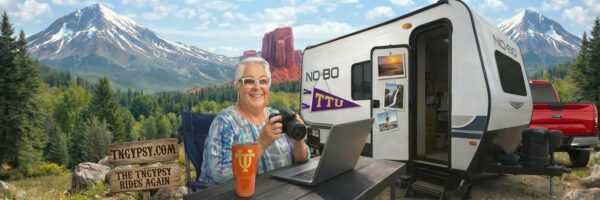
I began my second year of living life on the road exactly where the whole adventure started: Spring Hill, Tennessee. It felt fitting to return to the place where I first pulled away from a stationary life and stepped into this rolling one. While I was there, I visited the Columbia Peace and Justice Initiative’s new statue of Thurgood Marshall, commemorating his historic visit to Columbia. My friend, Patrick Carter, played a large role in its construction so I had to visit it. It was beautifully done — thoughtful, dignified, and exactly the kind of public art that honors both history and community. I also took care of the obligatory doctor visits, checked in with friends, and tied up the loose ends that always seem to gather when I circle back to Tennessee.

From there, I set out to drive the Natchez Trace Parkway — a 444‑mile route managed by the National Park Service. The Trace isn’t just a scenic road; it’s one of the oldest travel corridors in North America, with more than 10,000 years of human history behind it. Indigenous peoples — including the Natchez, Chickasaw, and Choctaw — used this route for trade, diplomacy, and ceremony long before Europeans arrived. In the late 1700s and early 1800s, it became the return path for the Kaintucks, boatmen who floated goods down the Mississippi River, sold their flatboats, and then walked home along the Trace. Inns called “stands” sprang up to feed and shelter them. Soldiers, settlers, enslaved people, traveling preachers, and even Meriwether Lewis all moved along this same corridor.

Today’s Parkway follows the approximate path of the Old Trace, linking archaeological sites, preserved sunken trail segments, burial mounds, and Civil War locations. Driving it feels like slipping into a quieter century.
I had already driven the Nashville‑to‑Columbia stretch, so this time I picked it up in Columbia and followed it all the way to just north of Natchez, Mississippi. The Trace carried me through Tennessee, Alabama, and Mississippi, and it was everything I hoped it would be: quiet, scenic, and peaceful. Fall was nearly over, but there was still color clinging to the trees. With no truck traffic and long, gentle curves, it was the kind of drive that lets your shoulders drop and your mind wander. I stopped often — for overlooks, historical markers, and the occasional monument — letting the rhythm of the road set the pace.
Of course, I made the obligatory stop in Tupelo, a city I’d never visited before. I’m not a huge Elvis fan, but he was part of the soundtrack of my generation, so I visited his restored boyhood home and the music center on the property. The fence‑line mural of musical icons was beautifully done. It wasn’t a long stop, but it was one I was glad to check off the list.

After finishing the Trace, I settled for a couple of weeks in the small town of Edwards, Mississippi, which gave me the chance to explore downtown Jackson. The old Mississippi State Capitol — a striking Greek Revival building — is no longer used as a functioning statehouse. It has been fully restored and now serves as the Old Capitol Museum, a National Historic Landmark dedicated to Mississippi’s political and legislative history. The last of the fall foliage framed it perfectly, and I left with a photograph I’m still proud of.

I also visited Vicksburg, a place I’ve always approached with mixed emotions. The Civil War has never been an easy subject for me; I have distant relatives who died in that conflict, and I’ve always felt conflicted about how to hold that history. But I appreciated the care taken in Vicksburg to honor the enormous loss of life on both sides. It’s a somber place, but an important one.
From there, I headed to a spot I’d wanted to see for years because it appears in so many travel blogs: Caddo Lake, in northern Louisiana. Since I had already done New Orleans last year, I took the northern route this time. I was lucky enough to find a month‑long campsite right on the lake for a very reasonable price. It turned out to be one of the most tranquil stays I’ve had — mornings with mist rising off the water, birds everywhere, and sunsets that felt like they were painted just for me. I even managed to catch a sunrise or two, helped along by the fact that the sun was taking its sweet time coming up.

After Caddo Lake, I made a brief stop in Shreveport–Bossier City due to an RV issue. It wasn’t planned, but at least I got a quick look at the area. Then I pushed west toward Las Cruces, New Mexico, breaking up the long haul across Texas with a stop along the way. Texas is simply too big to conquer in one day. The consolation prize was a spectacular Texas sunset — a reminder that even the longest stretches of road have their gifts.
And with that, I found myself wintering in the Southwest once again, grateful for the warmth, the wide skies, and the sense that year two on the road was off to a beautiful start.
