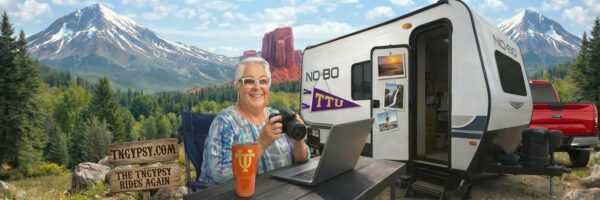
Utah has five national parks — the “Mighty Five.” Over the years, I had visited four of them. In 2011, Natasha, Brenna, and I camped our way through Arches and Canyonlands, surviving windstorms in our tent and driving a rented Jeep far closer to canyon edges than any of us needed to be. In 2013, during my first gypsy trip, I made it to Bryce and Zion. That left one: Capitol Reef.

If you missed last year’s journey through Colorado: Across the Divide –
Or Western Nebraska and Smith Falls: Kinda Home and a Picture it took 20 years to get! –
As I left Page and headed toward Torrey, I stumbled across two unsuspecting fun facts tucked into the wide‑open spaces of southern Utah: the birthplace and homestead of Billy the Kid, and the second Sevier County. I assume the county was named for the Sevier River — though I still don’t know why the river carries that name — but what caught my attention was that there are only two counties in the entire country named Sevier. One of them happens to be the place I call home whenever I’m required to name a real one.

Torrey, Utah, the small, friendly town that serves as the gateway to Capitol Reef National Park, was my next stop. Torrey is tiny — a single main road, a handful of restaurants, a cidery, and a scattering of inns and RV parks — but it has a charm that sneaks up on you. Everyone there is either supporting the tourism that comes with being next to a national park or is visiting the park themselves. It creates a sense of shared purpose, a quiet camaraderie. I settled in for a week, determined to finally see the park I had missed for more than a decade.

Capitol Reef gets its name from two things:

Capitol Dome : “Capitol” for the white domes of Navajo sandstone that resemble the U.S. Capitol building • “Reef” for the Waterpocket Fold, a 100‑mile‑long wrinkle in the Earth’s crust that created a barrier — a “reef” — to early travelers

The Waterpocket Fold is the star of the park. It’s a massive geologic uplift where layers of rock have been tilted, bent, and exposed, creating cliffs, domes, canyons, and deep pockets where water collects after rain.
Capitol Reef is quieter than the other Utah parks. Less crowded. Less commercial. More contemplative. It feels like a place that has been waiting patiently for you to arrive.
There are three major routes into Capitol Reef from Torrey, and over the course of the week, I explored all of them.
1. The Main Park Entrance (Highway 24)
This is the classic route — the one that takes you past towering cliffs, orchards planted by early Mormon settlers, and the historic Fruita district. Fruita is a tiny oasis in the desert, with green grass, fruit trees, and a one‑room schoolhouse that looks like it stepped out of a history book.

The petroglyphs along this road are some of the most accessible in Utah. Figures carved by the Fremont people — hunters, dancers, animals — stand quietly on the rock walls, watching the centuries pass.
2. The Scenic Drive into the Canyons
Turning right off the main road takes you deep into the heart of the Waterpocket Fold. The canyon walls rise higher, the colors deepen, and the road narrows until you feel like you’re driving through a stone cathedral.

3. The Road to the Open Plains
Another turn takes you out toward the open desert — wide, sweeping views, distant mesas, and the kind of sky that makes you feel small in the best possible way.

Each road showed me a different face of Capitol Reef. Each one was worth the drive.
Capitol Reef is a place where geology and history intertwine. The Fremont people lived here from about 300 to 1300 AD, leaving behind petroglyphs, granaries, and traces of their daily life. Later, in the late 1800s, Mormon settlers established the tiny community of Fruita, planting orchards that still bear fruit today. Visitors are allowed to pick apples, peaches, and cherries in season — a sweet reminder of the people who once called this place home. But the real story is the land itself.
Over the course of the week, I made sure to see all the key sites:
I also stopped at the little Torrey cidery, where I enjoyed a glass of freshly made cider — crisp, cold, and perfect after a day in the desert sun. Torrey may be small, but it knows how to welcome travelers.
1. Striped Chinle formation
2. Rippled Moenkopi layers
3. The petroglyph panels
4. The massive domes that give the park its name
5. The buttes and monoliths rising like ancient sentinels
6. The narrow canyons carved by water and time
7. Deep red Wingate sandstone cliffs

Capitol Reef doesn’t shout the way Zion does. It doesn’t overwhelm you like Bryce. It doesn’t have the iconic arches of Arches or the vastness of Canyonlands. Instead, it invites you to look closer, pay attention to details, and appreciate the centuries of history. Capitol Reef may not be the most famous of Utah’s national parks, but it has a quiet power all its own. It’s a place I’m grateful to have finally seen — and one I would happily return to visit again.
